
Joost Kruytzer of BigCircle Ventures: “We bring to life what is left on the shelf”
Fundsup spoke with Joost Kruytzer of BigCircle Ventures, an experienced entrepreneur and “venture builder” committed to accelerating technological solutions in climate and circularity.
With a background in physics and after many years in consulting and the startup world, Kruytzer founded BigCircle together with three co-founders. Their mission: turn breakthrough innovations from laboratories into impactful startups. In this interview, he talks about his motivations, BigCircle’s unique venture building model, and why now is the moment for investors to step into deeptech for a more sustainable future.
To start with your background, your passion, and why you started BigCircle…
“I was trained as a theoretical physicist, but I quickly discovered that I really enjoyed setting up new initiatives together with a team. That is why, after my studies, I moved into consulting, where I worked for over twenty years. After an initial period, I went to London to set up a new consulting firm during the dot-com boom. After that, I took my first step toward impact. For two years I supported local NGOs in Sri Lanka as a volunteer. Back in the Netherlands, I worked as a consultant in the healthcare sector and helped a small consultancy grow, after which we became internationally active through KPMG.”
And when did startups come into the picture?
“A few years later, as a partner, I left consulting to move into startups. I saw how critical technology is for keeping healthcare accessible, both here and in emerging markets. I met the founder of NLC, the venture builder in healthcare. From 2016 onwards, I worked there as COO, to help develop the model and build the organisation. After creating a hundred startups, I realised this venture building model was also badly needed in other sectors. I started focusing on climate and circularity, two challenging areas full of underused technology. That led to the birth of BigCircle.”
What specifically motivated you?
“My motivation is twofold: solving major societal challenges and the joy of creating something new with a team. I started BigCircle together with three co-founders – experts in climate and circularity – to complement their deep domain knowledge with my venture building experience. We are now a team of nine, working with almost all Dutch universities and launching the first ventures. Next year we will expand further and start collaborating with universities internationally as well.”
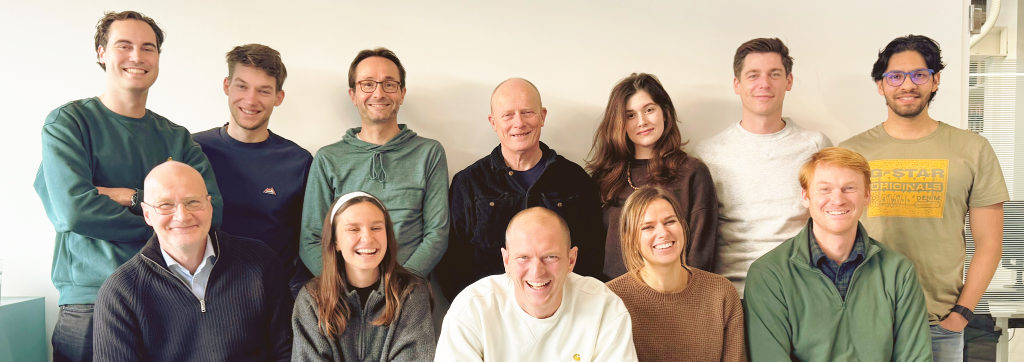
The BigCircle team.
And why focus specifically on deeptech in climate and circularity?
“Because these are huge societal challenges where technology is essential. Europe produces a tremendous amount of innovation, but much of it never makes it out of the lab. We bring that technology—often still at lab stage—to market. Think of decarbonising the steel industry, next-generation solar panels, or plastic recycling. These are solutions with enormous impact, but long development timelines. Our venture building model speeds up that process and increases the chances of success.”
Why choose venture building instead of just investing?
“We are not primarily an investor, although we do provide seed capital as support. Our core activity is creating startups. Together with universities and their research groups, we look for inventions that, for the wrong reasons, are left unused. Often that is because researchers want to continue their scientific work and do not take up entrepreneurship themselves.”
Don’t universities already have people for that?
“Universities have Tech Transfer Officers (TTOs) who help scientists commercialise their inventions. But they have limited capacity and cannot take on every innovation. That is where we come in. We assess the potential, just like an investor would, and only select technologies with real commercial promise. When we find one, we sign a licensing agreement with the university, set up a new company, and assemble a founding team. Usually that’s one or two people who step in as directors, together with us as co-founders.”
And how do you find the right people to lead these startups?
“Through our network, recruiters, and a lot of conversations. We look for entrepreneurs who can work well with universities but also hold their own in the market. Scientists often stay involved, but others lead the startups. Our role then shifts to that of an active shareholder, whereby we help with financing, legal structure, and market entry.”
What are the investment opportunities for investors?
“There are three ways to invest with us. The first is through the venture builder itself: this is the earliest stage, with the highest risk but also the highest potential upside. Because we build dozens of startups, there is immediate diversification of risk. This route often appeals to angel investors who want to stay close to the development process. The second route is through our closed-end fund. Here you invest slightly later, once the ventures have been formed. It is still early stage, but with a more traditional structure. This fund will ultimately include around thirty ventures, offering broad diversification. Finally, there’s the option to invest directly in individual ventures. Some investors join in via the builder or the fund to stay close to the pipeline and potentially participate more actively in a specific startup later on. At the moment, an investment round for the venture builder is open: interested parties can reach us via our website.”
Do you also work with existing startups?
“No, our model is really focused on technology that is still sitting on the shelf at universities or companies. If a startup is struggling but has valuable IP, we may look at acquiring it. But we are not an accelerator for existing teams.”
Why are these themes interesting for investors right now?
“Climate and circularity are not just impact themes—they are also strategically important for our economy. Europe wants to become independent in energy and materials. That requires technological innovation, exactly what we focus on. These are large markets, with strong momentum from policy, geopolitics, and industry. Impact and returns go hand in hand here.”
Do you receive government support, or do you prefer to remain independent?
“Both. Government subsidies help in early-stage technological development, but we do not want to become too exposed to policy shifts or restrictive conditions. Our goal is to make that very first stage of commercialising research investable, so more private capital can flow in.”
How do you reduce risk for investors?
“First, we increase the success rate of each individual startup by selecting high-potential technologies, building strong founding teams, and supporting them intensively. We also benefit from building dozens of startups, which helps us develop knowledge, networks, and strong in-house support. Second, through our structure, investors do not have to take the extreme risk of a single deeptech startup. By bundling dozens of ventures into one model, or investing through a fund, we spread risk and make it more attractive for both institutional and angel investors.”
Should investors be comfortable with dilution?
“Yes, because in principle that is a good thing: it means there is enough capital to bring the technology to market. Some ventures need less capital, others more, but by having a clear financing roadmap from the start, we ensure they reach the right investors at the right time.”
How is your portfolio doing after the first year?
“Since last summer we have been working with fifteen Dutch universities and research institutions. We currently have four pilots running, including a publicly announced project with Utrecht on next-generation plastic recycling. We are on track: on average it takes about a year from initial lab proof to launching a startup.”
Why invest now specifically?
“As I said, Europe wants to become energy and material independent, and compete through innovation. So political and economic necessity are aligning. Deeptech in climate and circularity is therefore getting a strong, long-term push. ‘Never waste a good crisis’: now is the time to build, to capture strategic markets in the long run.”
About the author: Pieter Bas is Startup Relations Associate at Fundsup.